Cigar Lounge Furniture and Ventilation: A Planning Guide for Owners and Designers (2026)
How to plan a cigar lounge: legal checks, ventilation principles, seating layout, leather and fire risk, side tables and ashtray placement, with a checklist.
Short answer: A successful cigar lounge is designed air-first and furniture-second. Confirm that smoking is legally permitted in your space, have a mechanical engineer design dedicated exhaust that holds the room at negative pressure, then lay out low, deep leather club chairs and sofas at generous spacing, with a side table and a heavy ashtray within reach of every seat. Choose protected leathers and smoulder-resistant upholstery composites, and keep furniture clear of supply and return grilles.
Cigar lounges look simple: leather chairs, dark wood, low light. Behind that look sit three hard constraints that a normal cocktail bar never faces: smoking law, ventilation engineering and ignition risk at every seat. This guide walks through how those constraints shape the furniture plan.
Is smoking allowed in your cigar lounge?
Check this before anything else, because it decides whether the project is indoor, outdoor or not viable at all.
- United States. Smoke-free laws are set by states, counties and cities. Many prohibit smoking in bars and restaurants but contain exemptions for cigar bars or retail tobacco establishments. These exemptions often come with conditions such as tobacco sales thresholds, separate ventilation, age limits, or a cut-off date that grandfathers older venues only. The rules differ significantly between jurisdictions.
- United Kingdom. Smoke-free legislation prohibits smoking in enclosed and substantially enclosed public places and workplaces. In England, a structure with a roof is generally treated as substantially enclosed if more than half of its wall area is enclosed, which is why UK cigar terraces are designed with at least half of their perimeter open. Your local authority interprets and enforces the rules.
- Gulf states. Smoking venues are licensed locally, often through the municipality, tourism authority and civil defence. Requirements for separation, ventilation and fire protection can be detailed and vary by emirate or city.
In every market, ask your licensing authority and fire officer early. The answer decides whether you are furnishing an indoor lounge, a covered terrace or both.
How should a cigar lounge be ventilated?
The furniture plan depends on the air plan, so understand the principles even if an engineer does the design.
- Dedicated exhaust, no recirculation into other areas. ASHRAE Standard 62.1 requires spaces where smoking is permitted to be separated from smoke-free spaces. Air from the smoking area must not be recirculated or transferred into smoke-free areas.
- Negative pressure. The lounge should be held at negative pressure relative to adjoining spaces, so air flows into the lounge when doors open rather than smoke leaking out. Vestibules or self-closing doors help.
- Much higher air change than a dining room. ASHRAE 62.1 does not publish a ventilation rate that makes tobacco smoke "acceptable"; it simply notes that smoking areas need more ventilation and/or air cleaning. Cigar lounge systems are therefore engineered case by case, with air change rates far above those used in normal dining rooms.
- Filtration and air cleaning. High-efficiency particle filtration captures smoke particles, and activated carbon or similar media address odour and gases. Neither replaces exhaust.
- Air pattern. Smoke rises with warm air. Many lounges supply air low or at mid-level and extract at high level above seating groups, so smoke is carried up and away from guests' faces. That pattern only works if the furniture does not block it.
What this means for furniture: ask your engineer for the supply and return grille positions before finalizing the layout. High-backed booths and banquettes placed against low-level supply diffusers can short-circuit the airflow, and a large sofa parked under a dead zone can leave a corner permanently hazy.
What furniture works best in a cigar lounge?
Cigars take 45 minutes to two hours or more to smoke, so seating has to support a long, relaxed sit.
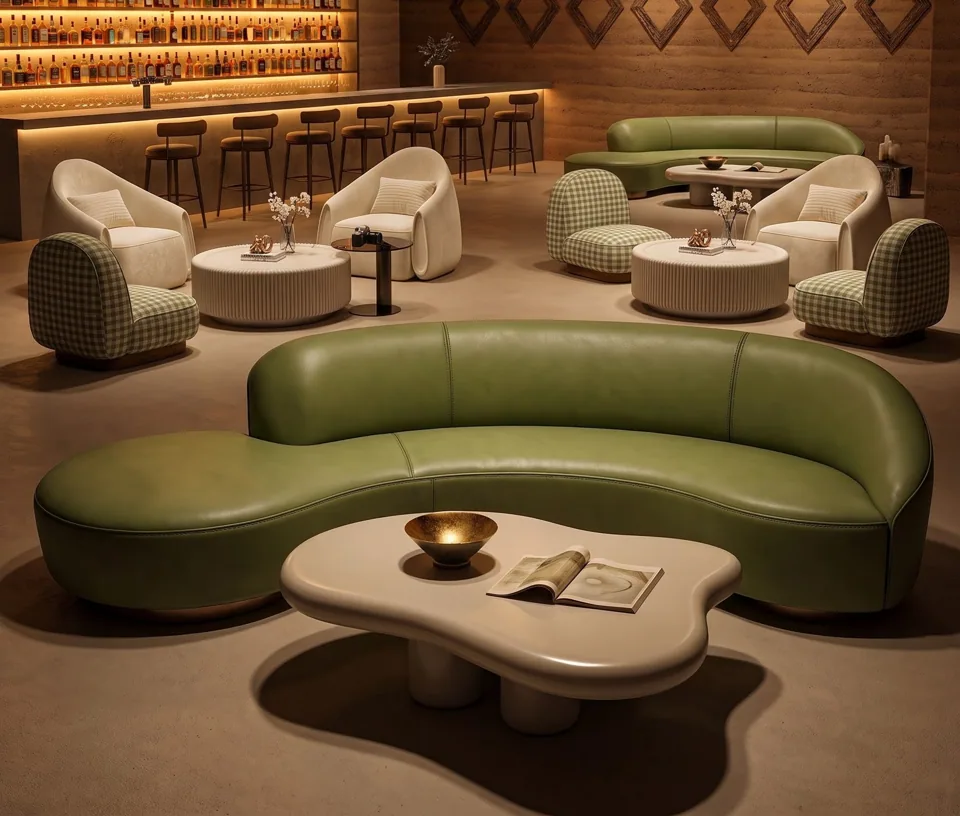
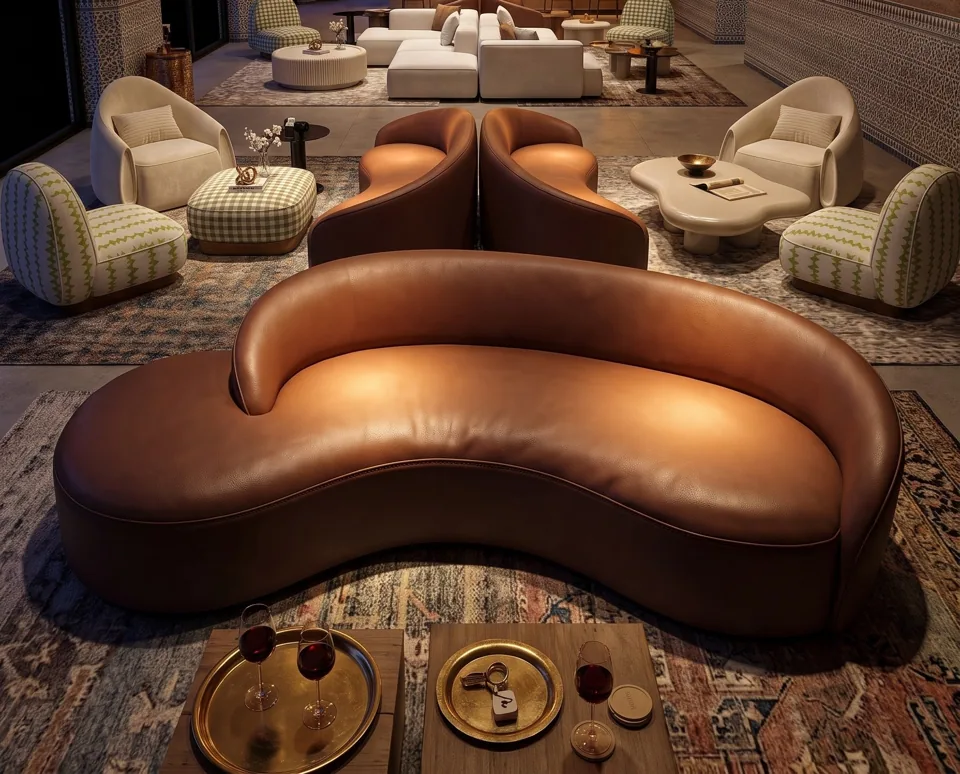
- Club chairs are the core of the room: low seat (around 15.5-17 in / 40-43 cm), deep seat, enveloping arms and a back that supports the shoulders when reclining. Our Cognac Shell Club Chair was designed for exactly this posture.
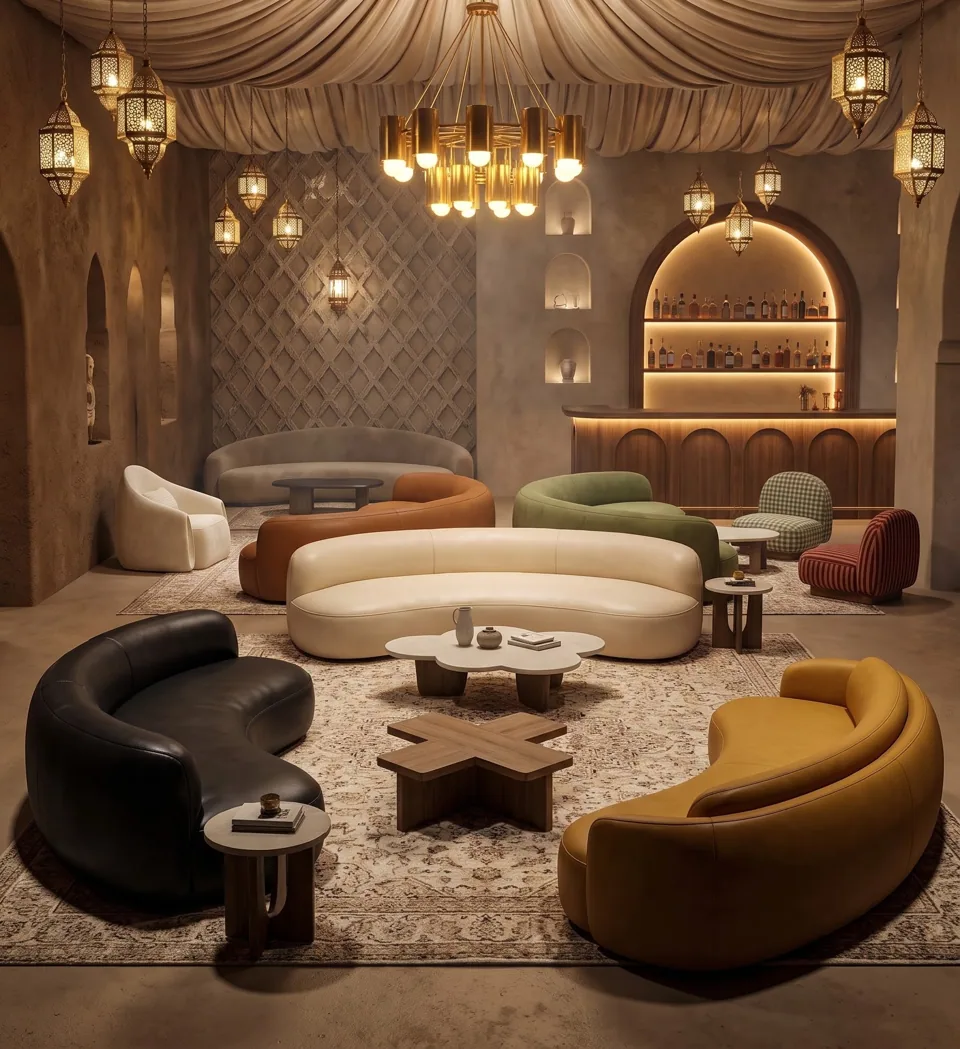
- Two- and three-seat sofas and settees serve couples and small groups and anchor conversation areas.
- Booths work on walls and in private bays but are less common than loose seating, because guests want to turn toward one another and toward the TV, fireplace or humidor display.
- Side tables at arm height, about 20-24 in (51-61 cm), one per chair, for ashtrays and glasses.
- Low cocktail tables at 15-18 in (38-46 cm) at the centre of each group.
- Bar or counter seating if the lounge has a bar, sized to the bar height (see our bar stool guide).
Leather, fabric and ignition risk
Smoking materials are a well-documented cause of upholstered furniture fires, which is why smoulder (cigarette) resistance tests exist in nearly every market. A dropped ember sitting in a seat crevice is the scenario these tests simulate.
- Leather generally performs well against smouldering ignition and tends to char rather than melt where an ember lands. Finished leather is also relatively easy to wipe clean of ash and absorbs less odour than open-weave fabric.
- Synthetic fabrics and vinyls vary. Some melt or burn through where hot ash falls, leaving permanent damage.
- Wool is naturally slow to ignite and tends to char, which is why wool rugs and wool-rich upholstery are common in traditional smoking rooms.
- The composite matters. Fire tests are performed on the combination of cover, interliner and filling. In the US, upholstered seating typically follows CAL TB 117-2013, a smoulder-resistance standard; in the UK, contract seating is commonly tested to BS 7176 using the BS 5852 ignition sources; in the EU, EN 1021-1 (cigarette) and EN 1021-2 (match-flame equivalent) are widely used. Your fire officer decides the requirement for your venue.
We specify fire-retardant foams, interliners and covers to the destination market's rules on request, and supply test reports for specific items where available.
Cigar lounge seating layout: space per guest
Lounges need far more floor area per guest than bars. Guests sit back, stretch out and need room for a side table.
| Seating type | Approx. footprint per piece | Floor area to plan per seat (incl. circulation) |
|---|---|---|
| Club chair + side table | 30 × 32 in chair (76 × 81 cm) + 18-20 in (46-51 cm) table | 25-35 sq ft (2.3-3.3 m²) |
| Two-seat settee | 55-63 in × 30-34 in (140-160 × 76-86 cm) | 20-30 sq ft (1.9-2.8 m²) |
| Lounge booth | Per 24-26 in (61-66 cm) of seat length per guest | 15-20 sq ft (1.4-1.9 m²) |
| Bar stool at a cigar bar | 26-30 in (66-76 cm) centre to centre | 10-12 sq ft (0.9-1.1 m²) |
These are planning ranges for comfort, not code minimums. Your occupant load for egress is calculated separately under the building code your jurisdiction uses.
Layout principles
- Groups of two to four. Arrange chairs in pairs or fours around a cocktail table, with 14-18 in (36-46 cm) between seat front and table edge.
- Clear routes. Keep accessible routes at least 36 in (91 cm) wide, and main circulation wider so staff can carry trays and guests can pass seated groups.
- Ash within reach. No guest should have to lean forward or stand up to reach an ashtray. One side table per chair is the rule.
- Separate the humidor. A walk-in humidor room is typically held around 65-72% relative humidity. Keep upholstered pieces and timber furniture out of that environment; wood moves and leather can be affected by sustained high humidity.
- Plan fireplace and TV sightlines. Many members' lounges orient groups toward a focal point; booths with tall backs can block it.
Checklist: planning cigar lounge furniture
- Confirm with the licensing authority that smoking is permitted and on what conditions.
- Get the ventilation concept from a mechanical engineer: exhaust, pressure, filtration and grille positions.
- Confirm the fire requirement for upholstered seating with your fire officer.
- Set the seat count using 25-35 sq ft (2.3-3.3 m²) per club-chair seat as a comfort benchmark, then check occupant load.
- Choose leathers: protected or semi-aniline for most seats, aniline only where patina is wanted.
- Specify a side table beside every chair and heavy, deep, non-combustible ashtrays.
- Lay furniture over the grille plan and adjust for airflow.
- Approve shop drawings and swatches; request a sample of the main chair.
- Plan cleaning: daily ash removal from crevices, weekly leather cleaning with pH-neutral products.
Common mistakes
- Designing the room before confirming the smoking law. Some projects discover too late that only a terrace can be smoking.
- Treating air purifiers as ventilation. Portable cleaners help, but they do not replace a dedicated exhaust system.
- Blocking low-level supply grilles with banquettes. The airflow pattern breaks and the room never clears.
- Too few side tables. Guests put ashtrays on chair arms and seat cushions, which is how burns happen.
- Lightweight ashtrays. They tip and scatter embers. Use heavy, deep glass, ceramic or metal.
- Specifying aniline leather everywhere. It will absorb more odour and show ash marks quickly.
- Copying residential seat heights. Dining-height seats at 18-19 in (46-48 cm) feel upright and wrong in a lounge.
FAQ
What is the best upholstery for a cigar lounge?
Protected or semi-aniline leather on a smoulder-resistant composite is the most common professional choice. It wipes clean, absorbs less odour than fabric and generally resists ember damage better than many synthetics. Browse our club chairs collection for typical builds.
How many seats fit in a 1,000 sq ft cigar lounge?
As a comfort benchmark, at 25-35 sq ft per seat you would plan roughly 28-40 lounge seats, fewer if the area includes a bar, humidor or service station. The legal occupant load is a separate calculation under your building code.
Do I need special furniture fire ratings for a cigar lounge?
You need to meet whatever upholstered-furniture requirement your jurisdiction and fire officer apply to your occupancy. Because smoking is the main ignition risk, smoulder-resistance performance matters most. Ask for test data on the full composite, not just the cover.
How do I stop leather chairs smelling of smoke?
Good ventilation is the main control. Beyond that, clean leather weekly with a pH-neutral cleaner, empty ashtrays frequently, and choose protected or semi-aniline finishes, which absorb less odour than aniline.
Can cigar lounge furniture be used outdoors on a terrace?
Only pieces built for outdoor use should stay outside. Indoor leather and upholstery will degrade in sun and rain. For covered terraces, specify outdoor-grade frames and performance fabrics, and bring leather pieces indoors.
Tell us about your bar or lounge: a floor plan, seat count and a few reference images are enough to start. We reply with a seating proposal and a quote.
Request a quote